
Knowing When Repairs Are No Longer Enough
Every commercial roof reaches a point where patching and repairing are no longer cost-effective. The challenge for business owners and property managers is recognizing that point before a catastrophic failure forces an emergency replacement at the worst possible time.
A planned roof replacement allows you to budget, schedule work during a slow season, and choose the best materials and contractor for your needs. An emergency replacement after a roof failure means water damage to your building interior, disrupted business operations, and decisions made under pressure.
Here are the five warning signs that your commercial roof is approaching the end of its useful life.
1. Persistent Ponding Water
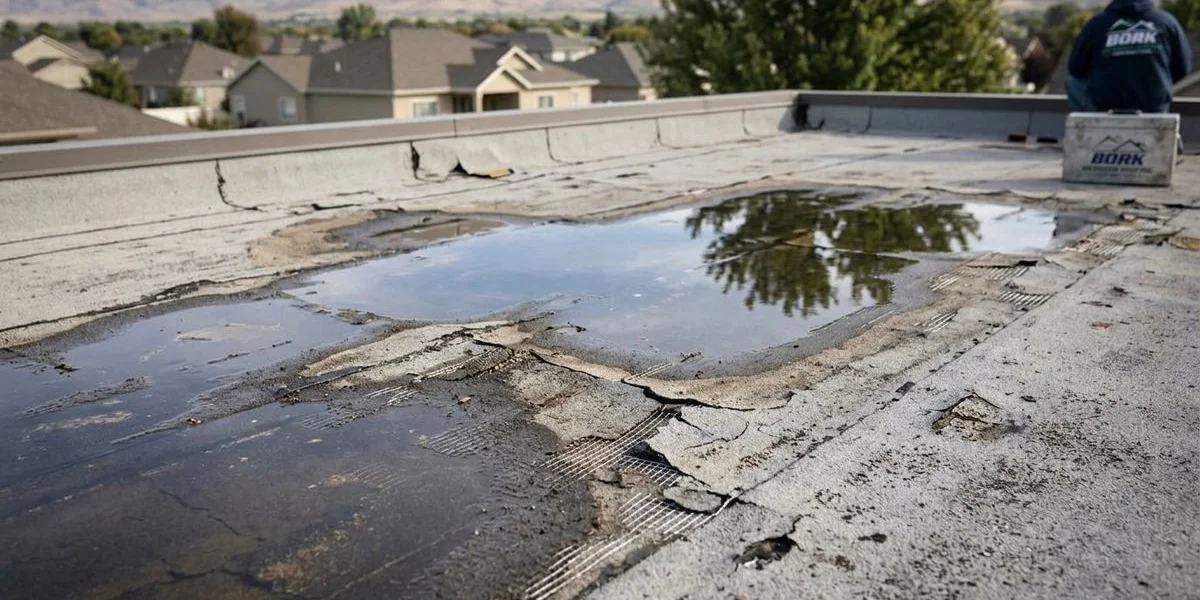
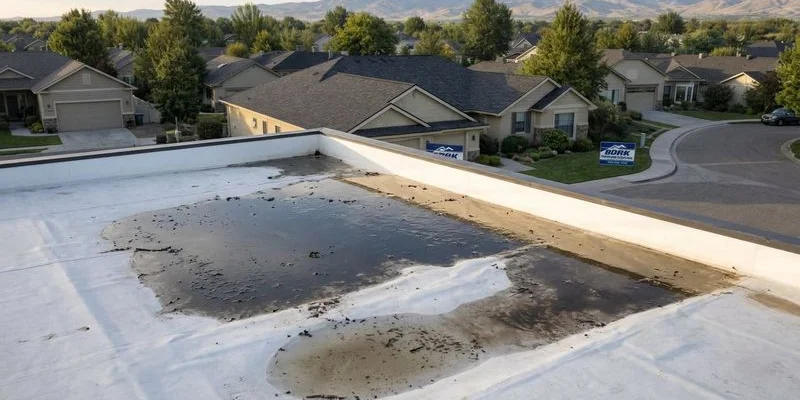
Flat and low-slope commercial roofs are designed to shed water, not hold it. Proper drainage through internal drains, scuppers, or gutters should clear water from the roof surface within 48 hours after rain. If water remains on your roof longer than that, you have a ponding problem.
Why Ponding Is Dangerous
Standing water accelerates membrane deterioration in several ways:
- UV amplification: Water acts as a lens, concentrating UV rays on the membrane below
- Weight stress: Water weighs approximately 5.2 pounds per square foot per inch of depth. A 10-by-10 foot ponding area with 2 inches of water adds over 1,000 pounds to your roof structure
- Freeze-thaw damage: In Idaho’s climate, ponded water freezes and expands in winter, stressing the membrane and the seams
- Biological growth: Standing water promotes algae and vegetation growth that deteriorates the membrane
If ponding is caused by a clogged drain, clearing the drain solves the problem. But if ponding is caused by structural settling, deteriorated insulation that has compressed, or design flaws, the underlying issue needs to be addressed. Persistent ponding that cannot be resolved with drainage improvements is often a sign that a full replacement with proper slope corrections is the right solution.
2. Membrane Tears, Splits, and Open Seams
The membrane is your roof’s primary defense against water. When the membrane itself is compromised, the clock is ticking.
What to Watch For
- Splits and cracks in the membrane field, especially on EPDM roofs where the rubber becomes brittle with age
- Open seams where sheets of membrane have separated at the overlapping joints
- Fish mouths where seam edges have curled up and separated, creating pockets that catch wind and water
- Punctures from foot traffic, dropped tools, or blown debris
Small, isolated tears and punctures can be patched. But when membrane damage is widespread across multiple areas of the roof, the material has reached the end of its service life. Patching a failing membrane is like patching a worn-out tire: it buys time, but it does not solve the underlying problem.
Seam Failures
On both TPO and EPDM roofs, seam integrity is critical. Seams are the most vulnerable points in any single-ply roofing system. If seams are failing in multiple locations, the adhesive or weld that holds them together has degraded beyond the point of reliable repair.
3. Saturated Insulation
Beneath the membrane, your commercial roof has a layer of rigid insulation that provides thermal performance and structural support. When moisture penetrates the membrane through leaks, punctures, or failed seams, this insulation absorbs water like a sponge.
Signs of Saturated Insulation
- Soft or spongy areas when walking on the roof surface
- Interior leaks that appear far from the point of entry on the roof (water travels along saturated insulation before finding a way through)
- Higher energy bills as wet insulation loses most of its R-value
- Thermal imaging during professional inspections reveals hot or cold spots where insulation is compromised
Saturated insulation cannot be dried out effectively once it is waterlogged. It must be removed and replaced. If the insulation is saturated in multiple areas, a full tear-off and replacement is typically more cost-effective than trying to replace insulation in isolated sections while leaving aging membrane in place.
4. Interior Water Damage and Active Leaks
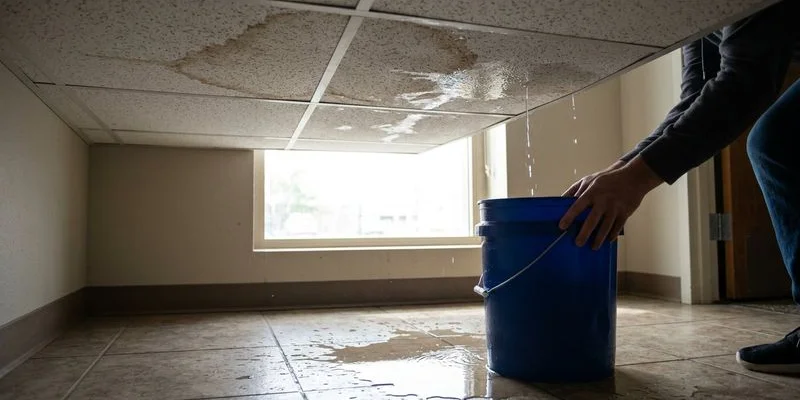
This might seem obvious, but many commercial property owners tolerate small leaks for far too long. A leak that shows up as a ceiling stain or a drip during heavy rain is a symptom of a roof that is failing to do its primary job.
The Hidden Cost of Leaks
What you see inside your building is usually the tip of the iceberg. By the time water reaches the interior:
- It has traveled through the membrane, insulation, and roof deck
- It may have saturated a large area of insulation that is not visible
- It may be causing hidden mold growth in ceiling cavities
- It is deteriorating the structural roof deck
If your building has active leaks that recur after repairs, or if new leaks appear in different locations, the roof system as a whole is failing. Continued patching becomes a losing battle.
5. The Roof Has Exceeded Its Expected Lifespan
Every roofing material has an expected service life. When your commercial roof approaches or exceeds that lifespan, replacement should be part of your planning even if problems have not yet appeared.
Typical Commercial Roof Lifespans in Idaho
- EPDM (rubber): 25 to 35 years
- TPO: 20 to 30 years
- Modified bitumen: 20 to 30 years
- Built-up roofing (BUR): 20 to 30 years
- Metal: 40 to 60 years
These ranges assume proper installation and regular maintenance. Poor installation, deferred maintenance, or severe storm damage can significantly shorten a roof’s life.
Planning Ahead
If your roof is within five years of its expected end of life, now is the time to start planning. A planned replacement gives you the advantage of:
- Budget preparation: Spreading the cost over a fiscal planning cycle
- Scheduling flexibility: Choosing a time that minimizes disruption to your business
- Material selection: Evaluating options like TPO, EPDM, or metal without time pressure
- Competitive bidding: Getting quotes from multiple qualified contractors
Waiting until the roof fails eliminates all of these advantages.
The Cost of Waiting Too Long
The financial argument for proactive replacement is straightforward. Emergency roof repairs and damage mitigation typically cost 2 to 5 times more than a planned replacement. Add in the cost of water damage to your building interior, including damaged inventory, equipment, flooring, and drywall, and the case for acting before failure is clear.
For Treasure Valley businesses, Idaho’s weather adds urgency. If your commercial roof fails in October, you may face months of winter weather before a replacement can be properly completed. Temporary measures during winter are expensive, imperfect, and stressful.
Get a Professional Assessment
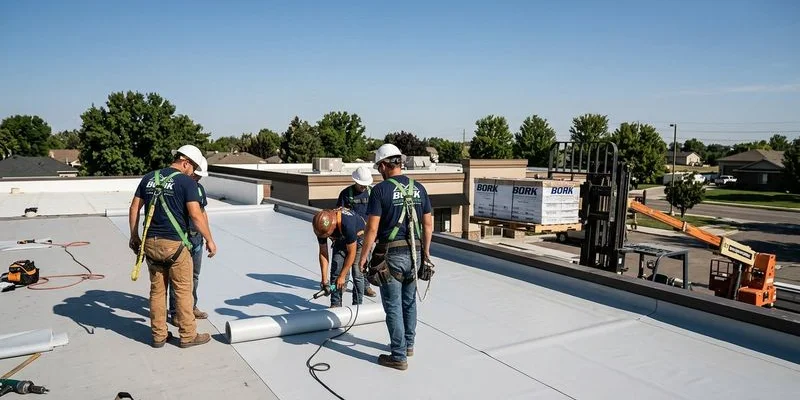
If your commercial roof is showing one or more of these warning signs, the next step is a professional assessment. At Bork Roofing, we provide thorough commercial roof inspections that include a detailed report on the condition of every component, from the membrane to the insulation to the deck.
We will tell you honestly whether your roof has years of life remaining, whether targeted repairs make sense, or whether replacement is the most cost-effective path forward. Our goal is to help you make the best decision for your building and your business.
Contact us today to schedule your free commercial roof assessment and start planning for the future.