
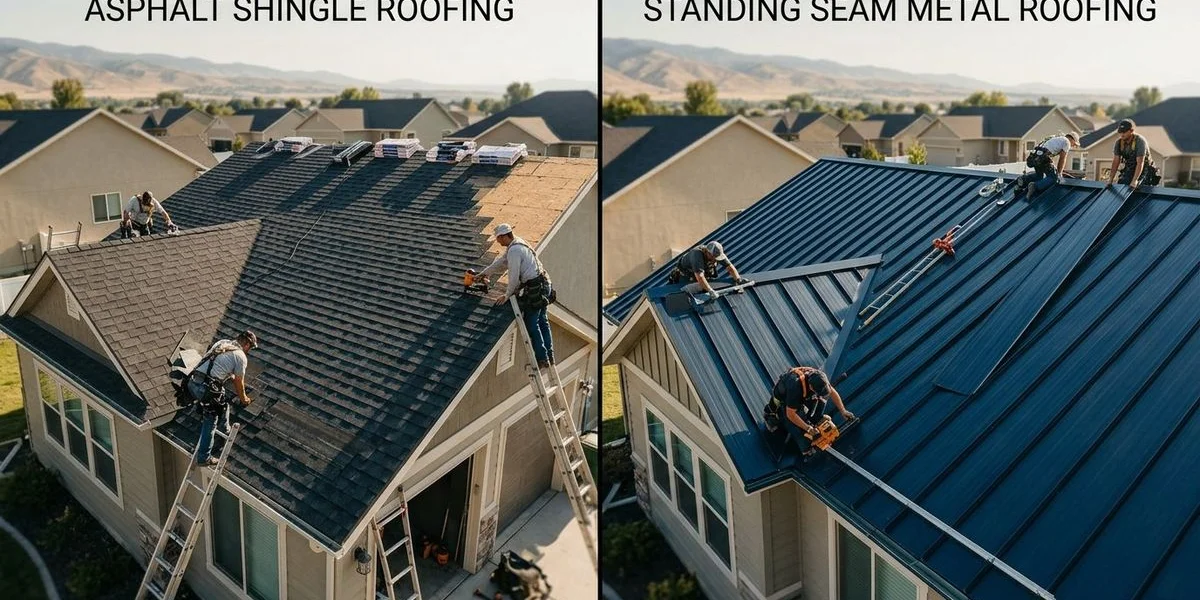
Choosing the Right Roofing Material for Your Idaho Home
You know how tricky it can be to balance immediate costs with long-term value when improving your home.
We see this struggle every day.
The choice often feels like a gamble between saving money now or preventing headaches later.
When planning a roof replacement in Idaho, the material you select impacts more than just curb appeal.
It dictates how your home handles the heavy snow loads of the Treasure Valley.
Our team has found that for most residents in Meridian and Boise, the decision narrows down to two strong contenders.
You are likely debating between asphalt shingles and metal roofing.
This guide moves beyond generic advice to give you the specific data and local insights needed to make the right call.
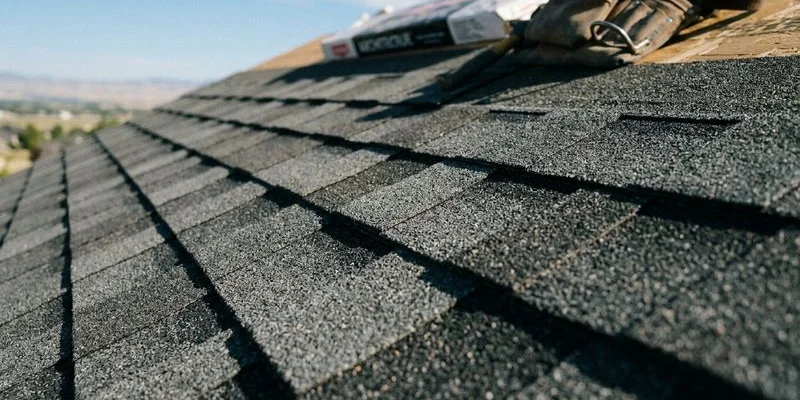
Asphalt Shingles: The Trusted Standard
Asphalt shingles remain the most common choice for residential roofing in Idaho.
We find that their popularity stems from a reliable mix of upfront affordability and straightforward maintenance.
Manufacturers like GAF and Owens Corning have optimized these products to handle standard weather patterns effectively.
Cost and Value
Your budget is often the primary driver for this choice.
We currently see installed costs for architectural shingles ranging from $450 to $700 per “square” (100 square feet) in the Boise area.
This price point makes shingles accessible for most homeowners.
Three-tab shingles are cheaper, often falling between $350 and $550 per square.
Experience shows, however, that three-tab options rarely hold up against Idaho wind speeds and are becoming obsolete in our market.
Lifespan and Durability
You can expect a standard architectural shingle roof to last 20 to 25 years in our local climate.
Our installers often see that while warranties promise 50 years (Limited Lifetime), the intense UV exposure at Idaho’s altitude degrades asphalt faster.
Thermal shock is another factor to consider.
Idaho summers feature hot days and cool nights, causing rapid expansion and contraction that can lead to granular loss over time.
Weather Performance in the Valley
Asphalt shingles perform adequately against rain and moderate wind.
We recommend looking for shingles with a Class 3 or Class 4 impact rating if you live in hail-prone pockets of the valley.
These ratings can prevent the cosmetic damage that often leads to insurance claims.
Wind resistance is also a key feature.
Most quality architectural lines are rated for 110 to 130 mph winds, which covers the typical gusts we see during spring storms.
Metal Roofing: The Long-Term Investment
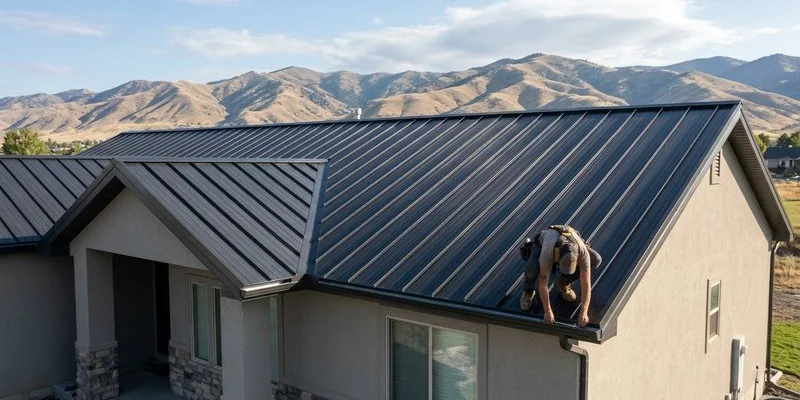
Metal roofing has shifted from barns to bungalows across the Treasure Valley.
We have noticed a surge in requests for standing seam metal roofs on residential properties in the last five years.
Homeowners are recognizing that modern metal systems offer a sleek aesthetic that pairs well with both farmhouse and contemporary styles.
Cost Analysis
The initial investment for metal is significantly higher than asphalt.
You should budget between $900 and $1,600 per square for a high-quality standing seam metal roof.
Stamped metal shingles, designed to mimic slate or shake, typically range from $700 to $1,200 per square.
Our analysis indicates that while the upfront check is larger, the cost per year of service is often lower due to the extended lifespan.
Lifespan Expectations
Metal roofing is a “one-and-done” solution for many people.
We see properly installed standing seam systems lasting 40 to 70 years with very little intervention.
Steel roofs coated with Kynar 500 or Hylar 5000 finishes resist fading and chalking for decades.
This longevity means you will likely never need to replace the roof again as long as you own the home.
Handling Idaho Winters
Metal excels in snow country.
We advise homeowners that metal sheds snow quickly, preventing the heavy buildup that can stress structural framing.
However, this shedding capability requires a specific safety addition.
You must install snow guards or snow rails over entryways and heavy traffic areas to prevent “roof avalanches” from burying your patio or walkway.
The Hail Factor
Hail is the one weakness for certain types of metal roofing.
Our team suggests using a minimum of 24-gauge steel for residential projects.
Thinner 26-gauge or 29-gauge panels (often used on pole barns) will dent easily during a hailstorm.
While these dents are usually cosmetic and do not cause leaks, they can affect your home’s resale value and appearance.
Side-by-Side Comparison for Idaho Homeowners
Making a direct comparison helps clarify which trade-offs you are willing to accept.
Here is how the data stacks up for the specific conditions we face in the Treasure Valley.
| Feature | Architectural Asphalt Shingles | Standing Seam Metal Roofing |
|---|---|---|
| Typical Lifespan | 20-25 Years | 40-70 Years |
| Wind Rating | 110-130 mph | 140+ mph |
| Maintenance | Moderate (moss removal, loose shingles) | Low (inspection of fasteners/sealants) |
| Snow Management | Holds snow (friction); risk of ice dams | Sheds snow; requires snow guards |
| Fire Rating | Class A (Good) | Class A (Non-combustible) |
| Recyclability | Low (often goes to landfill) | High (100% recyclable) |
Energy Efficiency and Cooling
Summer heat in Meridian can be brutal on your cooling bills.
We find that metal roofing reflects a significant amount of solar radiation.
This reflectivity can lower roof surface temperatures by up to 50 degrees compared to dark asphalt.
The result is a reduction in cooling costs by 10 to 25 percent.
Asphalt shingles absorb heat, which radiates into your attic and forces your air conditioner to work harder.
Noise Concerns
A common myth is that metal roofs are deafening in the rain.
We assure clients that this is rarely true for residential homes.
When installed over a solid plywood deck with high-quality underlayment and insulation, a metal roof is barely louder than asphalt.
You are more likely to hear the wind than the rain.
Impact on Resale Value
Both choices impact your home’s marketability differently.
Remodeling Magazine’s Cost vs. Value Report typically shows that metal roofing recoups roughly 48% to 55% of its cost at resale in our region.
Buyers love the idea of a maintenance-free roof.
Asphalt shingles recoup a slightly higher percentage (around 60%) simply because the initial outlay is lower, but they do not add the same “premium” factor to the listing.
Insurance Opportunities
Insurance companies love roofs that reduce their risk.
We encourage you to call your agent before choosing a material.
Many carriers, such as State Farm or Farm Bureau, offer premiums discounts of 20% to 35% for installing UL 2218 Class 4 Impact Resistant roofing.
Both metal and specially reinforced asphalt shingles can qualify for these savings.
Which Is Right for Your Situation?
The “best” roof is the one that aligns with your financial goals and future plans.
Choose Asphalt Shingles If:
- You are on a strict budget: The lower upfront cost allows you to allocate funds to other renovations.
- You plan to move soon: If you are selling in 5 to 10 years, you may not see the full ROI of a metal system.
- You have complex rooflines: Shingles are easier to cut and fit around dormers, valleys, and skylights, keeping labor costs down.
- HOA restrictions are strict: Some communities mandate the traditional look of architectural shingles.
Choose Metal Roofing If:
- This is your “forever home”: The long lifespan means you pay for the roof once and enjoy it for decades. Our guide on how long a roof lasts in Idaho breaks down expected lifespans by material.
- You want energy savings: The reflective properties pay dividends every July and August.
- You hate maintenance: Metal resists moss, algae, and rot, freeing you from annual roof cleaning tasks.
- You want modern aesthetics: The clean lines of a standing seam roof provide a distinctive look that stands out.
A Critical Note on HOAs
Neighborhood rules can be the ultimate dealbreaker.
We advise checking your Covenants, Conditions, and Restrictions (CC&Rs) before falling in love with a metal roof.
While some Meridian and Eagle communities are modernizing their rules to allow high-end metal profiles, others strictly prohibit them.
Getting architectural committee approval in writing is a mandatory step before materials are ordered.
Let Us Help You Decide
Your roof is the first line of defense against Idaho weather.
We believe that an informed homeowner makes the best decisions.
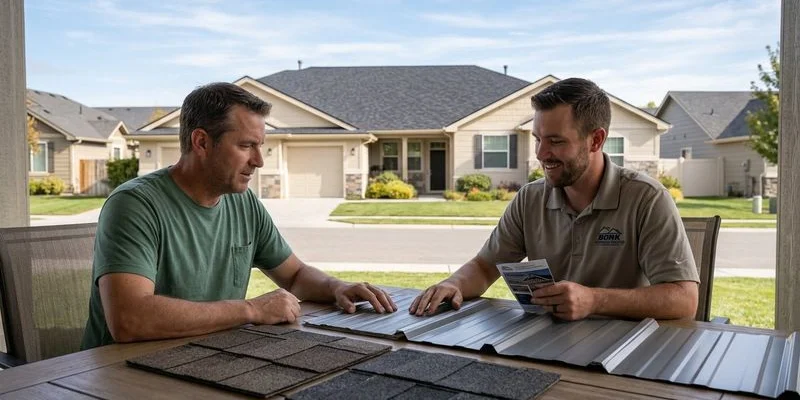
Our team at Bork Roofing installs both high-performance asphalt shingles and durable metal roofing systems across the Treasure Valley.
We take the time to calculate the total cost of ownership for your specific property so you can see the real numbers.
Contact us today for a free consultation and estimate.
We will inspect your current roof, discuss your long-term plans, and help you select the material that offers the perfect balance of protection and value.